Setting the Stage: Rural Health Challenges
Geographic isolation remains a fundamental barrier to health care in rural communities. In the United States, residents travel longer distances for primary and subspecialty services, while in India 86% of rural patients travel up to 100 km to reach a facility. These trips generate substantial travel costs and lost work time, contributing to higher out‑of‑pocket expenses—70‑80% of rural health spending in India and a notable share of U.S. medical bills. Uninsured rates are also elevated: 13.9% of non‑metropolitan adults in India lack coverage, and more than 10% of rural Americans remain uninsured, with 25% reporting serious problems paying medical bills.
Workforce shortages compound the problem. Rural U.S. areas have only 13 physicians per 10,000 people versus 33 in metropolitan zones, and similar gaps exist for nurse practitioners and dentists. India’s rural health system faces a 12% deficit of allopathic doctors at primary health centres and thousands of vacant specialist posts at community health centres. Limited broadband connectivity further restricts telehealth solutions; only 60.9% of U.S. rural households report broadband access, and 13.4% of Indian rural households lack broadband, hampering digital consultations and remote monitoring.
Finally, infrastructure gaps in diagnostic services leave rural patients without timely laboratory results. In India, merely 6.3% of rural respondents accessed diagnostics at government secondary facilities, while home‑based private services are still underutilised. The combined effect of distance, cost, workforce scarcity, digital divide, and diagnostic shortages creates a persistent health inequity that must be addressed through coordinated policy, technology, and community‑based interventions.
Bridging Diagnostic Gaps with Home Sample Collection
Free doorstep collection eliminates travel burden for rural patients by bringing the phlebotomist to the home, sparing journeys of up to 100 km, reducing time away from work, and cutting out‑of‑pocket transport costs. Patients can stay in their community while waiting for a specimen, which improves adherence to screening programs.
Logistical steps for remote villages include scheduling visits by trained community health workers (CHWs), using insulated containers and cold‑chain solutions such as solar‑powered refrigeration where electricity is unreliable, and promptly couriering specimens to the Agam Diagnostics hub. Quality is maintained through standard operating procedures, bar‑code labeling, and real‑time tracking of transit conditions.
Integration with CHWs is critical: they act as liaisons, educate families on test preparation, collect specimens, and transmit results via digital platforms. This partnership creates local employment, enhances health‑literacy, and ensures that diagnostic services are both affordable and accessible in underserved areas.
Accelerating Care Through Rapid Turnaround Times
Timely laboratory results are a cornerstone of effective chronic‑disease management in rural settings. When patients receive a diagnosis early, treatment can begin promptly, complications are a, and hospital stays are shortened—benefits that are especially valuable for communities that must travel long distances for care. Agam Diagnostics in Madurai addresses this need by delivering most routine panels within a 24‑48‑hour window, while urgent tests such as COVID‑19, cardiac biomarkers, and critical infectious‑disease panels are reported in under 12 hours. These Rapid turnaround times align perfectly with tele‑consultation workflows: clinicians conducting virtual visits can access lab data in near‑real time, make evidence‑based decisions, and prescribe treatment without delay. This synergy reduces the need for repeat travel, cuts out‑of‑pocket costs, and improves patient confidence in remote care. In short, rapid reporting enables early diagnosis, supports seamless tele‑health integration, and ultimately enhances health outcomes for rural patients.
Ensuring Quality: NABL and ICMR Accreditation
What accreditation means for test accuracy
Accreditation is a formal recognition that a laboratory meets rigorous, internationally‑accepted standards for testing procedures, quality control, and management systems. For patients and clinicians, it translates into reliable, reproducible results and faster clinical decision‑making.
NABL standards for laboratory practice
The National Accreditation Board for Testing and Calibration Laboratories (NABL) evaluates a lab on criteria such as personnel competence, equipment calibration, traceability of measurements, and continuous improvement processes. NABL accreditation therefore signifies that the laboratory can consistently deliver accurate, repeatable test outcomes, reducing the risk of diagnostic errors.
ICMR endorsement of public‑health relevance
The Indian Council of Medical Research (ICMR) accreditation focuses on alignment with national health priorities. It ensures that test menus, especially for infectious diseases and emerging health threats, support surveillance and public‑health programmes. ICMR endorsement complements NABL by confirming that the lab’s services are both technically sound and strategically valuable for India’s health system.
What does NABL accreditation signify for a diagnostic laboratory?
NABL accreditation confirms that the laboratory complies with internationally recognized standards for testing accuracy, repeatability, quality control, and management systems, ensuring reliable results for clinicians and patients.
How does ICMR accreditation complement NABL certification?
ICMR endorsement ensures that the laboratory’s methods and test menus align with Indian public‑health priorities, especially for infectious disease surveillance, and validates the laboratory’s role in national health programmes.
Telehealth Integration and Broadband Expansion
Broadband connectivity is the backbone of effective telehealth services in rural India. Reliable high‑speed internet enables stable video consultations, permits secure electronic transmission of test orders and results, and supports integration with e‑prescription platforms, thereby making remote specialist care feasible for patients who would otherwise travel long distances. To close the digital divide, the Government’s Digital India programme, satellite‑based internet initiatives such as PS‑STAR and OneWeb, and state‑funded community Wi‑Fi hubs are rapidly expanding broadband penetration in underserved villages. These efforts reduce the current 60.9 % rural‑urban connectivity gap, allowing clinics to link e‑prescriptions directly with laboratory results from providers like Agam Diagnostics, which offers free home‑sample collection and rapid turnaround. The combined impact of broadband expansion and telehealth integration improves access to timely diagnostics, lowers travel costs, and supports coordinated care for rural populations.
Accredited Social Health Activists (ASHAs) serve as a critical bridge between villages and diagnostic laboratories. By educating families about the value of preventive screening, scheduling home‑collection visits, and using standardized specimen kits, ASHAs bring laboratory services directly to remote households. Training modules for ASHAs focus on proper specimen handling, cold‑chain maintenance, and digital result delivery via mobile apps, ensuring sample integrity and rapid turnaround. Evidence shows that such training raises correct case management by about 14 % and improves adherence to treatment protocols, leading to higher diagnostic uptake. When ASHAs collect samples, travel barriers and out‑of‑pocket costs drop, allowing earlier disease detection and timely management of chronic conditions. The integration of ASHAs into diagnostic outreach thus expands coverage, reduces delays, and strengthens rural health systems.
Public‑Private Partnerships and Government Schemes
India’s flagship health programmes are expanding affordable diagnostics for rural residents. Ayushman Bharat (PM‑JAY) now covers senior citizens and links 12.37 crore families to cash‑less treatment, while the National Health Mission’s Free Essential Diagnostics Initiative supplies subsidised test kits and supports community‑health‑worker specimen collection. State‑level Health‑Wellness Centres (H&WCs) further extend these benefits by integrating primary‑care services with laboratory testing. To tap these programmes, private laboratories must become empaneled service providers. The process involves registration on the Ayushman Bharat Digital Mission platform, meeting NABL/ICMR accreditation standards, and agreeing to government‑mandated price caps for essential tests. Once empaneled, labs can offer discounted test packages, receive electronic health‑record referrals from H&WCs, and participate in bulk‑procurement schemes that lower per‑test costs. Partnerships also include joint tele‑pathology initiatives, where rural clinicians transmit samples and results through secure digital channels, ensuring timely diagnosis without patient travel. These collaborations create a sustainable, cost‑effective diagnostic network that bridges the urban‑rural health divide.
Cost Reduction via Hub‑and‑Spoke Model
The hub‑and‑spoke model in rural health care links a central laboratory (the hub) with peripheral primary health centres (spokes). The hub, such as Agam Diagnostics in Madurai, houses high‑complexity, fully automated analyzers and is accredited by NABL and ICMR, while spokes collect specimens, enter orders electronically, and receive results without owning expensive equipment. By concentrating sophisticated testing in one location, capital costs are shared and per‑test expenses drop through economies of scale. Rural patients no longer need to travel 50‑100 km to urban labs; instead, free home collection brings samples to the hub, cutting travel costs and lost work time. Providers at PHCs save on equipment purchase, maintenance, and staffing, allowing them to allocate resources to direct patient care. An example flow: a village ASHA gathers a blood sample, a courier transports it to Agam Diagnostics, the lab processes it within 24‑48 hours, and the result is delivered digitally to the PHC doctor, who can promptly initiate treatment. This streamlined pathway lowers costs for both patients and providers while improving diagnostic timeliness.
Mobile Diagnostic Vans and Point‑of‑Care Testing
Mobile diagnostic vans in rural India bring point‑of‑care testing directly to villages, offering on‑site blood glucose, hemoglobin, rapid antigen, and basic biochemistry panels, while also providing health‑education sessions and vaccinations. Equipped with solar‑powered refrigeration, they preserve temperature‑sensitive specimens for later analysis at a central hub such as Agam Diagnostics. These vans complement the free home‑collection service by reaching remote hamlets without reliable road access; home‑collection teams visit households unable to travel to the van, ensuring that even the most isolated residents receive timely testing. Together, the two models create a comprehensive coverage network that captures the majority of the rural population. This integrated approach accelerates early detection of non‑communicable diseases like diabetes and hypertension, enabling prompt clinical decision‑making and reducing the need for costly travel to distant health facilities. By lowering logistical barriers and delivering rapid results—often within 24‑48 hours—the combined system improves disease surveillance, supports timely treatment, and contributes to better health outcomes for underserved communities.
Financial Protection Through Insurance and Subsidies
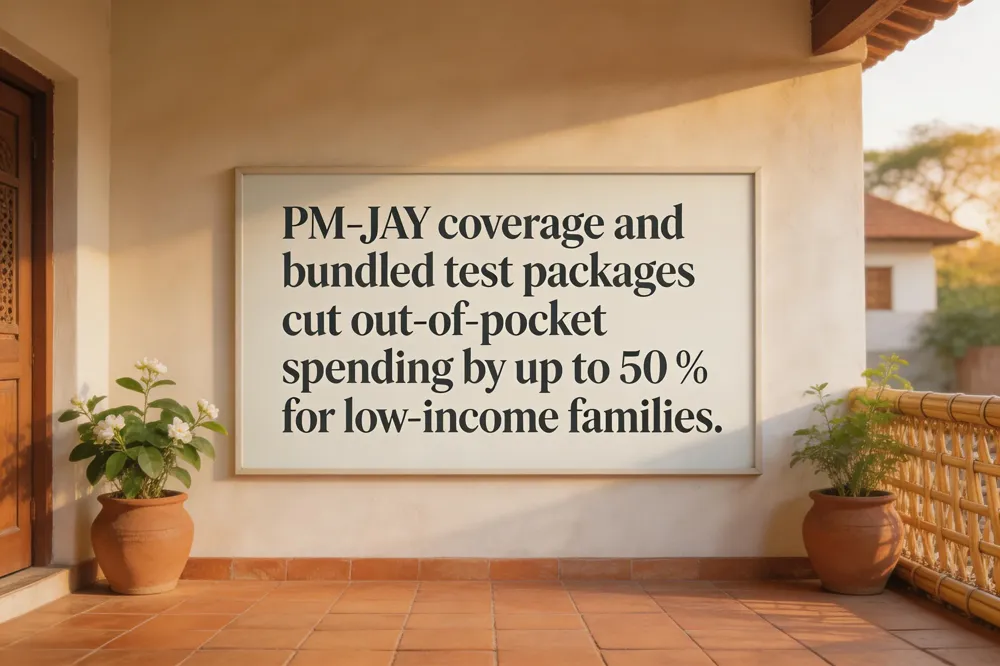
Ayushman Bharat’s PM‑JAY scheme provides up to INR 5 lakh per family per year, shielding low‑income households from catastrophic expenses and enabling them to obtain essential diagnostics without financial hardship. Bundled test packages, such as Agam Diagnostics’s diabetes or cardiovascular panels, lower per‑test costs by 30‑50 % and often include additional discounts for seniors, women, or children, making preventive screening and chronic‑disease monitoring affordable for rural families. These subsidies translate into a measurable reduction in out‑of‑pocket (OOP) spending: households with chronic illnesses report a 40‑% drop in monthly diagnostic expenses when bundled packages and insurance coverage are combined.
How does health insurance improve affordability of diagnostic services?
Insurance like PM‑JAY covers a substantial portion of test fees, reducing OOP costs and allowing patients to access high‑quality labs such as Agam Diagnostics without delaying care.
What is the impact of subsidised test packages on rural families?
Bundled panels cut overall testing costs, increase uptake of routine screening, and lessen the financial burden of managing chronic conditions, thereby improving health outcomes and economic stability.
Data‑Driven Public Health Surveillance
Effective surveillance in rural districts hinges on aggregating laboratory data from providers such as Agam Diagnostics. By compiling test results across haematology, biochemistry, immunology, microbiology, molecular biology, and medical genetics, health agencies can spot trends—rising diabetes markers, spikes in infectious disease indicators, or clusters of anemia—and map these as disease hotspots. Real‑time analytics transform raw numbers into actionable dashboards, enabling rapid allocation of resources, targeted vaccination drives, and focused health‑promotion campaigns that address the specific needs of each community.
Agam Diagnostics plays a pivotal role in this ecosystem. Its laboratory information system automatically flags abnormal patterns, anonymises the data, and shares concise dashboards with state health departments and national platforms such as U‑WIN and eSanjeevani. This partnership ensures that rural health authorities receive timely, reliable insights, fostering evidence‑based decision‑making and strengthening the overall public‑health response in underserved areas.
Future Outlook: Sustainable Rural Health
Scaling home‑collection and tele‑pathology will be central to bridging the diagnostic gap in rural communities. Models such as Agam Diagnostics in Madurai demonstrate how free doorstep sample pickup, rapid 24‑48‑hour turnaround, and NABL/ICMR‑accredited testing can eliminate travel barriers for patients who otherwise travel 50–100 km to the nearest lab. Coupled with tele‑pathology platforms, images and data can be transmitted instantly to specialist hubs, allowing timely interpretation without physical referral. Expanding this hub‑and‑spoke framework across state‑wide PHC networks will multiply coverage while keeping costs low.
Policy support for broadband expansion and workforce development is equally critical. The 2024 U.S. CMS Rural Health Strategy and India’s National Health Mission both cite internet connectivity and allied‑health provider scope as levers for improved access. Investing in rural broadband—currently only 60.9 % of U.S. and 13.4 % of Indian households lack adequate service—enables video consultations, e‑prescriptions, and real‑time result delivery. Simultaneously, training community health workers and nurse practitioners to collect specimens and operate point‑of‑care devices expands the provider pool where physicians are scarce.
Sustained public‑private collaboration will cement affordability. Partnerships that link government insurance schemes such as Ayushman Bharat with private labs, and that leverage NGOs to fund solar‑powered refrigeration for sample transport, have already reduced out‑of‑pocket costs. Replicating these models at national scale will ensure that high‑quality diagnostics reach every rural resident, supporting better health outcomes and economic resilience.