The AI Wave in Modern Healthcare
Artificial intelligence excels at ingesting massive, multimodal health datasets—imaging, lab results, electronic records—and extracting patterns far faster than human clinicians. Deep‑learning models scan millions of pixels in radiology images or analyze thousands of genomic variants within seconds, delivering quantitative risk scores and differential diagnoses in real time. This rapid processing translates into higher diagnostic accuracy: AI‑driven image analysis achieves sensitivity and specificity comparable to expert radiologists for diabetic retinopathy, breast cancer, tuberculosis, and cardiovascular risk prediction reaches 93 % classification accuracy in peer‑reviewed studies. By automating routine tasks such as slide triage, data entry, and quality‑control alerts, AI shortens turnaround times, enabling same‑day reporting in haematology, biochemistry, immunology, microbiology, and genetics.
Agam Diagnostics’ fully automated laboratory model embodies this promise. Leveraging AI‑enhanced workflow management, the lab integrates free home‑collection logistics, rapid sample routing, and AI‑based result interpretation across its NABL‑accredited and ICMR‑accredited services. The AI layer continuously learns from regional disease patterns, ensuring culturally sensitive, high‑quality diagnostics for underserved populations in Tamil Nadu and beyond. In this way, AI not only boosts speed and precision but also aligns directly with Agam Diagnostics’ mission to democratize access to accurate, timely patient care. These advancements foster a resilient health ecosystem that can scale with demand.
From Images to Insights: AI‑Powered Radiology
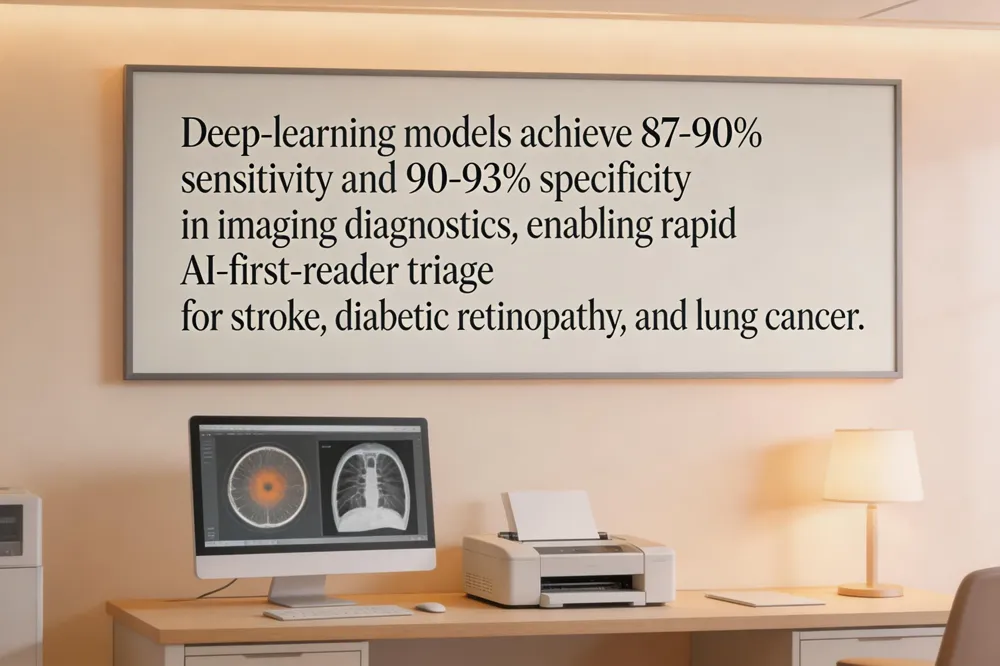
Deep‑learning models now analyze X‑ray, CT, MRI and ultrasound images at scale, automatically detecting subtle patterns that escape the human eye. Benchmark studies show these algorithms achieve sensitivity and specificity on par with expert radiologists—87%‑90% sensitivity and 90%‑93% specificity for diabetic retinopathy, breast cancer and tuberculosis screening, and comparable accuracy for hyper‑acute stroke identification (large‑vessel occlusion and salvageable tissue). Clinical deployments illustrate rapid triage: AI‑first‑reader tools flag suspected stroke on CT within seconds, prompting immediate thrombectomy pathways, while AI‑driven retinal scanners enable community‑level diabetic retinopathy screening with a single‑visit workflow. Regulatory milestones underscore safety: the FDA cleared IDx‑DR for autonomous diabetic retinopathy detection (2018) and recent 2025 approvals for AI‑based stroke‑CT analysis and lung‑cancer triage platforms. Together, these advances accelerate diagnosis, standardize care, and expand access to high‑quality imaging interpretation worldwide.
AI in the Laboratory: Accelerating Pathology and Haematology
Digital pathology platforms such as PathAI’s AISight® Dx, Indica Labs’ HALO, and Stanford’s Nuclei.io are reshaping slide‑image analysis. They convert glass slides into high‑resolution whole‑slide images, automatically detect cellular abnormalities, grade tumors, and quantify biomarkers (e.g., PD‑L1, HER2) with accuracy comparable to expert pathologists. In haematology, AI‑driven image analysis counts and classifies blood cells in seconds, providing differential counts and flagging atypical morphologies without manual microscopy. Fully automated laboratories like Agam Diagnostics in Madurai demonstrate dramatic turnaround‑time reductions—AI‑enabled workflows cut haematology, biochemistry, immunology, microbiology, and genetics reports from days to hours, often delivering same‑day results. Continuous quality‑control loops monitor assay performance in real time; AI flags instrument drifts, out‑of‑range values, and sample integrity issues, prompting immediate corrective action and ensuring compliance with NABL and ICMR standards. Together, these innovations accelerate diagnosis, improve reproducibility, and expand access to high‑quality pathology services.
Predictive Analytics: From Risk Scores to Proactive Care
Machine‑learning models that fuse ECG waveforms, laboratory values, and electronic health‑record (EHR) data have demonstrated cardiovascular‑risk classification accuracies of around 93 % in peer‑reviewed studies. Similar AI‑driven predictive analytics are being applied to sepsis detection—alerting care teams hours before physiologic deterioration—and to public‑health surveillance, where models forecast malaria and other disease outbreaks to guide proactive resource allocation. Economic utility analyses show that early AI‑identified interventions reduce intensive‑care stays and costly complications, delivering favorable cost‑benefit ratios for health systems. Real‑world validation studies, including those conducted in Indian automated laboratories such as Agam Diagnostics, corroborate these performance metrics while maintaining compliance with accreditation standards (NABL, ICMR) and safeguarding patient safety.
Genomics, the Medicine: AI‑Driven Molecular Diagnostics
Artificial intelligence now interprets next‑generation sequencing (NGS) data at scale, automatically detecting tumor‑specific mutations and structural variants with accuracy exceeding 90 %. By linking these genomic signatures to curated drug‑response databases, AI platforms suggest personalized oncology regimens that target the driver alterations while sparing patients the toxicity of broad‑spectrum chemotherapy. At Agam Diagnostics in Madurai, AI‑enhanced pipelines streamline the entire molecular workflow—from DNA extraction and library preparation to cloud‑based variant calling and clinical reporting—reducing turnaround times from weeks to days and ensuring compliance with NABL and ICMR standards. Looking ahead, quantum‑AI models promise faster training on ultra‑large genomic cohorts, while federated‑learning frameworks will allow multiple institutions to improve predictive algorithms without exposing raw patient data, preserving privacy and fostering globally representative precision‑medicine solutions.
Human‑Centred Design and Collaborative Development
Successful AI‑enabled diagnostics rely on multidisciplinary teams that bring together data scientists, clinicians, and engineers to co‑design models that reflect real‑world clinical workflows. By involving stakeholders early, labs such as Agam Diagnostics can embed cultural sensitivity and ethical guidelines into algorithms, ensuring compliance with Indian standards (NABL, ICMR) and global regulations (FDA). Human‑factors engineering is applied to create intuitive interfaces for laboratory staff and clinicians, reducing misuse and fatigue. Proactive risk‑assessment methods—particularly Failure‑Mode and Effects Analysis (FMEA)—identify potential AI system failures before they impact patient safety, allowing corrective actions to be built into the software and hardware design. This human‑centred, collaborative approach guarantees that AI tools augment, rather than replace, clinician expertise while maintaining safety, transparency, and regulatory adherence.
Operational Excellence: AI‑Optimized Lab Workflows
AI routing algorithms enable Agam Diagnostics to schedule free home‑sample pickups across rural Tamil Nadu, optimizing travel routes, balancing technician workload, and preserving specimen integrity. Once samples arrive, AI‑driven case‑triage systems dynamically prioritize urgent specimens—such as sepsis panels or oncologic markers—while predictive maintenance models forecast equipment wear, reducing downtime and ensuring continuous high‑throughput processing. Robotic process automation handles repetitive tasks including barcode labeling, aliquoting, and real‑time data entry into the Laboratory Information System, minimizing human error and accelerating turnaround. All workflow steps are continuously monitored by AI‑based quality‑improvement programs that flag out‑of‑spec, results, trigger corrective actions, and maintain compliance with NABL and ICMR accreditation standards. Together, these intelligent technologies create a seamless, rapid, and reliable diagnostic pipeline that expands access to high‑quality care for underserved communities.
Virtual Health Assistants and Patient Engagement
AI‑powered virtual health assistants are now available 24 hours a day, handling triage, symptom checking and medication reminders without fatigue. By integrating with wearable IoT devices—such as continuous ECG, pulse‑ox and glucose monitors—these assistants can stream real‑time vitals to clinicians and trigger alerts when early signs of sepsis, arrhythmia or decompensation appear. The resulting automation reduces repetitive inquiries for caregivers, freeing nurses and physicians to focus on complex decision‑making and cutting clinician burnout, as highlighted by the Philips Future Health Index 2025. Global deployments illustrate the impact: AI chatbots in the United Kingdom have shortened emergency department wait times, while in India’s National Digital Health Mission they support remote villages through mobile‑first triage. For Agam Diagnostics’s home‑collection network in Tamil Nadu, coupling AI assistants with patients’ wearable data can triage abnormal haematology or biochemistry results, prompt timely follow‑up, and ensure that remote patients receive the same rapid, personalized care as urban clinics.
Economic and Societal Impact: The Quadruple Aim in Action
Artificial intelligence is accelerating progress toward the ‘quadruple aim’ of healthcare. First, AI‑driven imaging and genomic analysis detect diseases such as diabetic retinopathy, breast cancer and tuberculosis directly improving population health. Second, automated pathology workflows—exemplified by Agam Diagnostics’ fully AI laboratory with free home collection—deliver results 20‑40 % faster, giving patients timely answers and reducing clinician fatigue, which enhances both patient and caregiver experience. Third, AI replaces repetitive manual tasks (e.g., data entry, slide triage, equipment monitoring) cutting labor costs, minimizing human error and optimizing resource allocation; studies report up to 30 % fewer diagnostic errors and up to 30 % faster turnaround times. Finally, AI mitigates workforce shortages highlighted by the COVID‑19 pandemic by scaling high‑volume tasks such as image classification and routine lab processing, allowing limited staff to focus on complex clinical care. Together, these advances deliver higher quality, more affordable, and more sustainable health services.
A Future Shaped by Trustworthy AI
Realizing the promise of artificial intelligence in diagnostics hinges on sustained, multidisciplinary collaboration. When data scientists, clinicians, and engineers co‑design models, they can embed clinical relevance, cultural sensitivity, and ethical safeguards from the outset, as demonstrated by the collaborative development frameworks highlighted across multiple studies. Continuous post‑deployment monitoring—using real‑time performance dashboards, failure‑mode and effects analysis, and explainable‑AI (XAI) visualizations—ensures that algorithms remain accurate, robust, and transparent as patient populations and practice patterns evolve. Ethical stewardship, including rigorous bias audits, patient‑privacy protections, and clear governance structures, builds the trust required for clinicians to rely on AI as a second reader rather than a replacement. Agam Diagnostics in Madurai, Tamil Nadu, epitomises this model: a fully automated, NABL‑ and ICMR‑accredited pathology laboratory that leverages AI for haematology, biochemistry, immunology, microbiology, molecular biology, and genetics. Its AI‑enhanced workflow reduces turnaround time, minimizes manual errors, and expands access through free home‑collection services for remote communities. By integrating continuous validation, explainability, and ethical oversight, Agam Diagnostics serves as a scalable blueprint for trustworthy, AI‑augmented pathology across India and beyond.