A New Era for Blood‑Disorder Care
The rapid expansion of cellular therapies, from CAR‑T cells (liso‑cel, ide‑cel) to bispecific antibodies, is reshaping treatment algorithms for B‑cell lymphomas, follicular lymphoma, and CNS‑involved myeloma, delivering response rates up 85% and durable remissions. Simultaneously, automation and AI‑driven hematology analyzers—integrating laser‑based flow cytometry, digital morphology, and machine‑learning flagging—are cutting turnaround times to minutes, enabling real‑time MRD monitoring and early detection of abnormal cells. Precision medicine is now anchored by comprehensive genomic profiling via next‑generation sequencing panels that uncover actionable mutations (e.g., BTK, BCL‑2, JAK‑STAT) and guide targeted regimens such as acalabrutinib + venetoclax or pelabresib + ruxolitinib. Together, these advances create a seamless pipeline from rapid, AI‑enhanced diagnostics to personalized, cellular‑based therapeutics, accelerating outcomes for patients with hematologic disorders.
CAR‑T Cells and Bispecific Antibodies Move to Earlier Lines
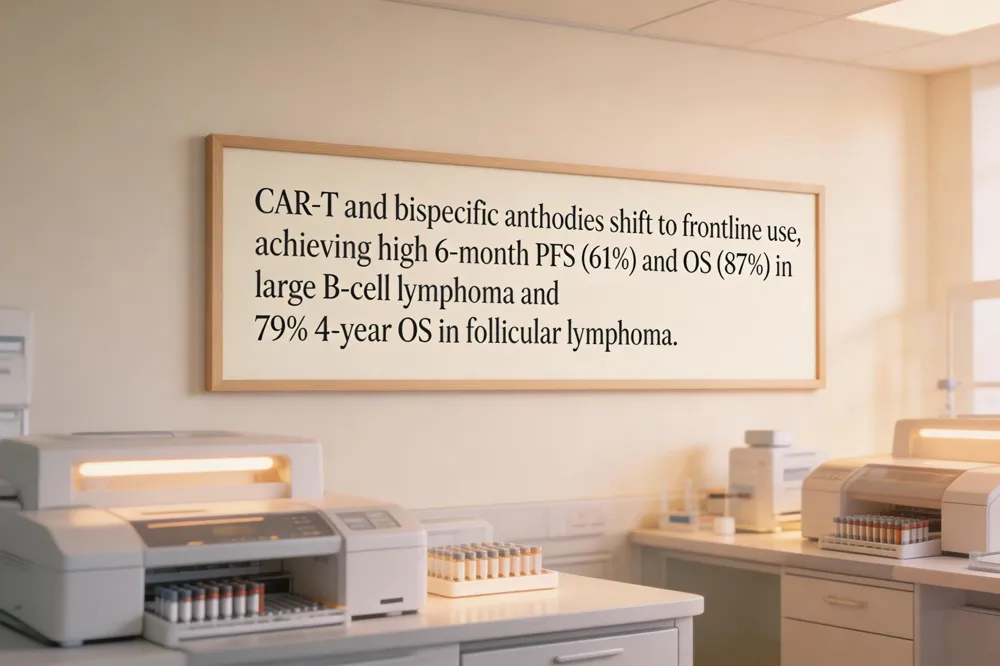
In 2024, CAR‑T and bispecific modalities are shifting from salvage to frontline use. Real‑world CIBMTR data (n = 156) showed lisocabtagene maraleucel (liso‑cel; Breyanzi) achieved a 6‑month PFS of 61 % and OS of 87 % as second‑line therapy for relapsed/refractory large B‑cell lymphoma, while the ELARA phase‑2 update reported tisagenlecleucel with a 4‑year OS of 79.3 % and a 69.1 % CR rate in follicular lymphoma. Dual‑target CD20/CD19 antibodies further lowered progression and death risk in follicular lymphoma (ASH LBA‑1). Bispecific T‑cell engagers are also delivering striking results: blinatumomab raised three‑year disease‑free survival to 97 % in pediatric B‑ALL, and epcoritamab produced a 61 % overall response rate in relapsed/refractory CLL after BTK and BCL‑2 inhibitor failure. These outcomes underscore the expanding role of immunotherapy earlier in treatment algorithms.
AI‑Driven Automation Accelerates Hematology Testing
Mindray’s newest hematology analyzers marry laser‑based flow cytometry, impedance and fluorescence to generate detailed cell morphology, Immature Platelet Fraction (IPF) and optical platelet counts in seconds. The integrated AI algorithms automatically flag abnormal cells, calculate derived parameters such as Reticulocyte Hemoglobin (RET‑He) and inflammation ratios, and dramatically cut the need for manual slide review. In parallel, digital morphology platforms like Mindray’s MC‑80 scan peripheral‑smear slides, apply deep‑learning models to detect blasts, atypical lymphocytes and other subtle changes, and feed the results directly into the laboratory information system. Agam Diagnostics in Madurai has built a fully automated, 24‑hour workflow around these technologies, offering free home collection, NABL and ICMR accreditation, and a turnaround‑ under 24 hours for complete blood counts and specialized hematology panels. Together, AI‑driven analysis and end‑to‑end automation are reshaping laboratory hematology by delivering faster, more accurate diagnoses while freeing technologists for higher‑value tasks.
Next‑Generation Sequencing Powers Precision Medicine
Comprehensive next‑generation sequencing (NGS) panels have become a cornerstone of modern hematology, especially for AML, MDS, and CLL. By simultaneously detecting mutations in genes such as FLT3, NPM1, DNMT3A, IDH1/2, and a broad array of epigenetic regulators, NGS enables clinicians to match patients with targeted agents and determine eligibility for novel therapies. In acute myeloid leukemia, the molecular risk signature (mPRS) stratifies individuals receiving hypomethylating agents plus venetoclax into three outcome groups, guiding intensity of treatment and informing prognosis. In mantle‑cell lymphoma, NGS‑enhanced minimal residual disease (MRD) assessment allows treatment de‑escalation, permitting omission of high‑dose chemotherapy and autologous stem‑cell transplant without compromising long‑term survival. These advances illustrate how NGS directly influences treatment selection, risk stratification, and therapeutic de‑intensification across hematologic malignancies.
Oral Targeted Agents and BTK Degraders Redefine CLL Therapy
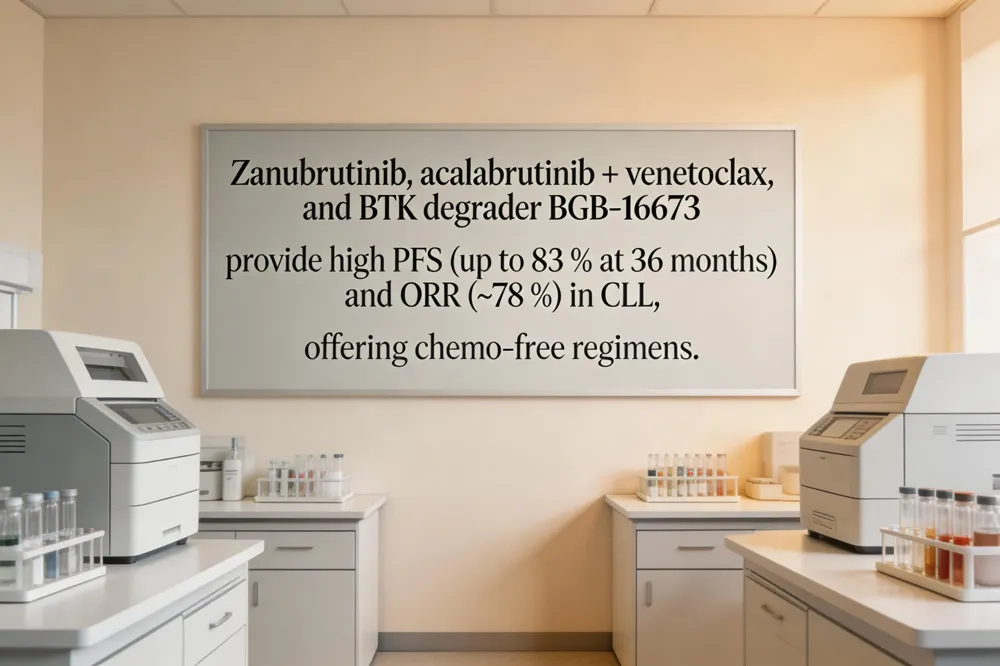
Oral agents are reshaping chronic lymphocytic leukemia (CLL) management. Five‑year SEQUOIA data demonstrate that zanubrutinib (Brukinsa) delivers superior progression‑free survival and a more favorable safety profile than bendamustine‑rituximab in treatment‑naïve CLL/SLL, establishing it as a new standard of care. The AMPLIFY phase‑3 trial showed that a fixed‑duration, all‑oral regimen of acalabrutinib plus venetoclax (doublet) achieved an 83.1% 36‑month PFS, markedly outpacing standard chemo‑immunotherapy. Emerging BTK degraders, exemplified by BGB‑16673, have reported an overall response rate of ~78% in relapsed/refractory CLL, offering a strategy to overcome resistance to conventional BTK inhibitors. Together, these oral therapies and novel degraders are redefining the CLL treatment paradigm by providing highly effective, chemotherapy‑free options with durable responses and improved tolerability.
Gene Therapy and CRISPR Move Toward Curative Hemoglobinopathies
Recent advances have turned gene‑editing into a realistic cure for hemoglobin disorders. Exagamglogene autotemcel (Exa‑cel) became the first FDA‑approved ex vivo CRISPR‑Cas9 therapy for sickle cell disease, editing the BCL11A enhancer in autologous hematopoietic stem cells to reactivate fetal hemoglobin and achieve durable transfusion‑independence. Lovotibeglogene autotemcel, a lentiviral vector that adds a functional β‑globin gene (HbAT87Q), received approval for sickle cell disease and expands the curative toolkit for both sickle cell and β‑thalassemia. Parallel pre‑clinical work is testing in‑vivo CRISPR delivery—using adeno‑associated viral capsids or lipid‑nanoparticle carriers—to edit hematopoietic stem cells directly in patients, which could eliminate the need for cell collection and ex‑vivo manipulation. These milestones collectively illustrate that precise genome‑editing is rapidly moving from experimental to therapeutic reality for hemoglobinopathies.
Lifestyle, Supportive Care, and MRD‑Based Strategies
Non‑pharmacologic factors are emerging as powerful modifiers of hematologic outcomes. Current pre‑clinical data (ASH abstract 259) show that higher dietary fiber intake after allogeneic stem‑cell transplantation attenuates gastrointestinal graft‑versus‑host disease and translates into better overall survival, likely through modulation of gut microbiota and inflammatory pathways. Conversely, smoking exerts a dose‑responsive increase in somatic mutational burden, accelerating the evolution of myelodysplastic syndrome to acute myeloid leukemia (ASH abstract 4597, underscoring the need for aggressive smoking cessation programs in at‑risk populations. In mantle‑cell lymphoma, minimal residual disease (MRD) monitoring now guides treatment de‑escalation: patients with MRD‑negative status can safely skip high‑dose chemotherapy and autologous stem‑cell transplant without compromising long‑term survival (ASH abstract LBA‑6. Together, these findings highlight how lifestyle interventions and MRD‑driven decision‑making can personalize care, reduce treatment toxicity, and improve survival across diverse hematologic diseases.
Looking Ahead: Integrating Innovation with Accessible Care
Automated laboratories such as Agam Diagnostics are already delivering cutting‑edge haematology testing—AI‑driven differential counts, rapid CBCs, and advanced flow‑cytometry panels—within 24 hours while offering free home collection and NABL/ICMR‑accredited quality. Scaling these capabilities nationwide will help India’s 1.5 million‑strong Madurai region and other underserved areas access molecular panels, MRD monitoring, and NGS‑based mutation profiling essential for personalized therapy. Equitable distribution of novel agents—CAR‑T cells, bispecific antibodies, oral BTK degraders, and next‑generation gene‑editing treatments—requires public‑funded reimbursement, regional trial sites, and tele‑pathology networks. Looking forward, AI‑assisted diagnostics, CRISPR‑based curative approaches, and fixed‑duration oral regimens (e.g., acalabrutinib + venetoclax) will further bridge the gap between breakthrough science and everyday patient care across India.