Why NABL Accreditation Matters for New Labs
NABL accreditation provides international recognition because NABL is a signatory to ILAC and APAC Mutual Recognition Arrangements, ensuring test reports are accepted worldwide without re‑testing. The accreditation framework aligns directly with ISO 15189 for medical laboratories and ISO 17025 for testing and calibration, embedding the same quality‑management and technical‑competence requirements demanded globally. For patients, this translates into reliable, accurate results, reduced diagnostic errors, and faster turnaround times, thereby enhancing safety and trust. For regulators and payers, NABL‑accredited labs demonstrate compliance with Indian health‑care laws, eligibility for government contracts, and seamless participation in national programs such as ICMR initiatives and continuous quality improvement.
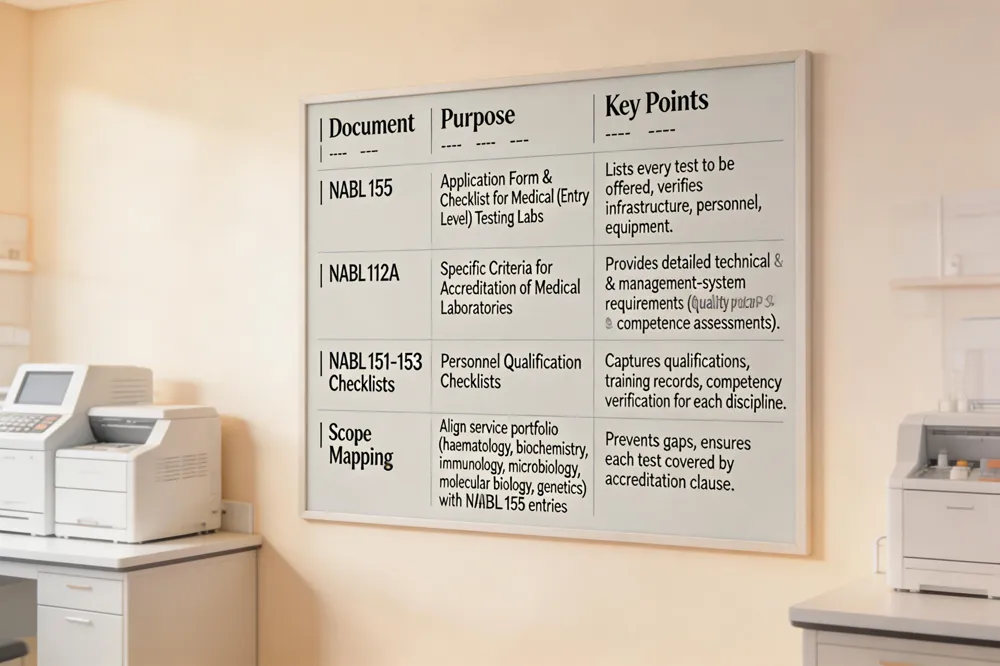
The first step for any new diagnostic lab in India is to download and complete NABL 155 – the official Application Form and Checklist for Medical (Entry Level) Testing Labs (Document No. NABL 155, issued 30 July 2020). This form forces the lab to list every test it intends to offer and to verify that the required infrastructure, personnel qualifications, and equipment are in place. Parallel to the application, NABL 112A – Specific Criteria for Accreditation of Medical Laboratories – provides the detailed technical and management‑system requirements that the lab must meet, such as documented quality policies, SOPs, and competence assessments. Using NABL 112A as a guideline, Agam Diagnostics can map its service portfolio – haematology, clinical biochemistry, immunology, microbiology, molecular biology and medical genetics – to the appropriate test‑scope entries in NABL 155. Clearly defining each discipline’s scope at this stage prevents later scope‑expansion gaps, ensures that every test is covered by a specific accreditation clause, and allows the laboratory to align its Quality Manual, SOPs and proficiency‑testing participation with the exact standards demanded by NABL.
2️⃣ Build a Robust Quality Management System (QMS)
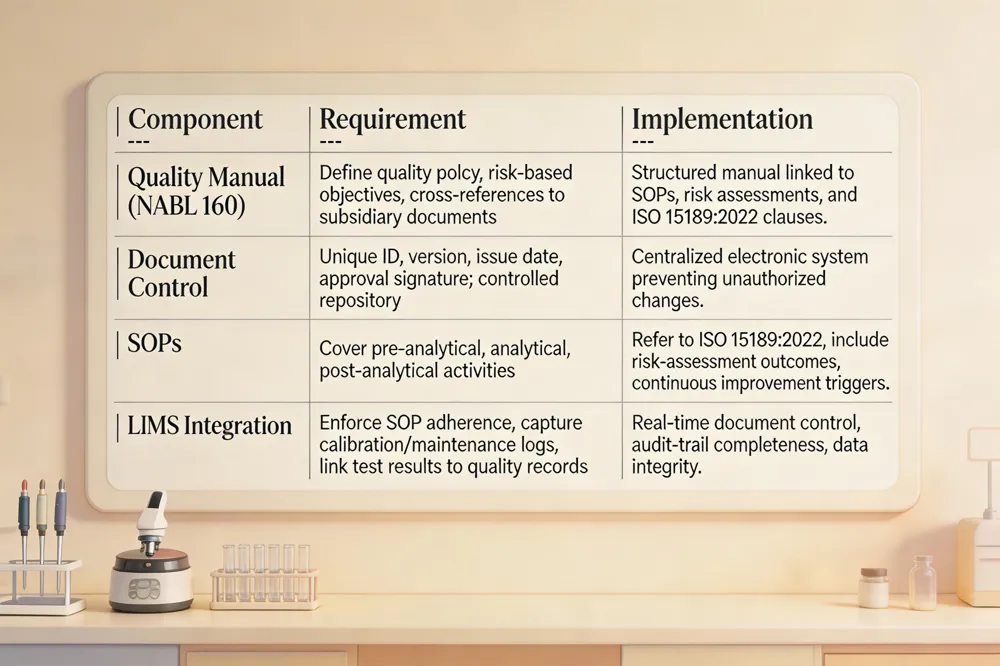
A solid Quality Management System (QMS) is the cornerstone of NABL accreditation and is guided by NABL 160 – the ‘Guide for Preparing Management System Documents/Quality Manual’ (issue 11/09/2018, amended 12/01/2026). The guide mandates a quality manual that defines the laboratory’s quality policy, risk‑based objectives, and cross‑references to all subsidiary documents. Document control is essential: each SOP, policy, and form must have a unique ID, version number, issue date, and approval signature, and must be stored in a controlled repository that prevents unauthorized changes. SOPs should cover every pre‑analytical, analytical, and post‑analytical activity, referencing the latest ISO 15189:2022 clauses and incorporating risk‑assessment outcomes that drive continuous improvement. Integrating the QMS with a Laboratory Information Management System (LIMS) ensures data integrity, traceability, and audit‑trail completeness; the LIMS can enforce SOP adherence, capture calibration and maintenance logs, and automatically link test results to the relevant quality records. Agam Diagnostics in Madurai, Tamil Nadu, leverages NABL 160 to structure its QMS, linking its automated analyzers and LIS to maintain real‑time document control, thereby meeting both national accreditation requirements and international quality benchmarks.
3️⃣ Ensure Personnel Competence and Training
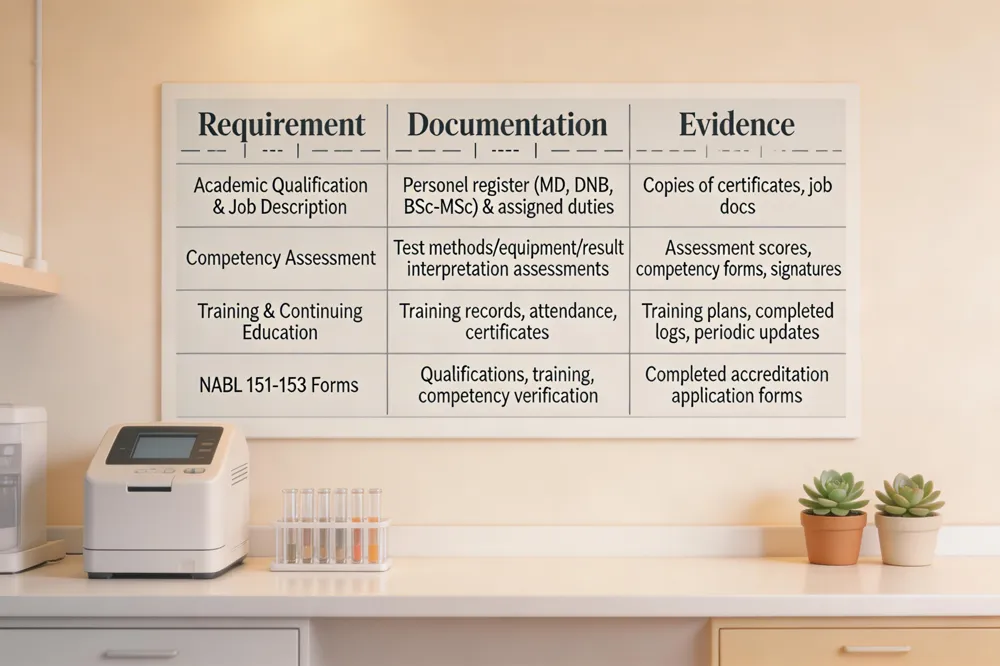
For a diagnostic laboratory such as Agam Diagnostics, NABL accreditation hinges on documented personnel competence across all test disciplines (haematology, clinical biochemistry, immunology, microbiology, molecular biology, genetics). Each staff member must hold the appropriate academic qualification (e.g., MD, DNB, BSc‑MSc) and be assigned a job description that matches the discipline. Competency is demonstrated through formal assessments that evaluate knowledge of test methods, equipment operation, and result interpretation, as required by ISO 15189:2022. All assessments, training sessions, and continuing‑education activities are recorded in a personnel register, with copies of certificates, attendance sheets, and competency‑assessment scores retained for the minimum period stipulated by NABL (typically three years). The NABL 151‑153 application and checklist forms provide the official template for capturing these details: Form 151 (application for testing labs), Form 152 (application for calibration labs), and Form 153 (application for medical labs) each include sections for qualifications, training records, and competency verification. Maintaining up‑to‑date documentation ensures the laboratory meets the NABL personnel‑qualification checklist and supports successful audit outcomes.
4️⃣ Implement Equipment Calibration, Maintenance, and Traceability
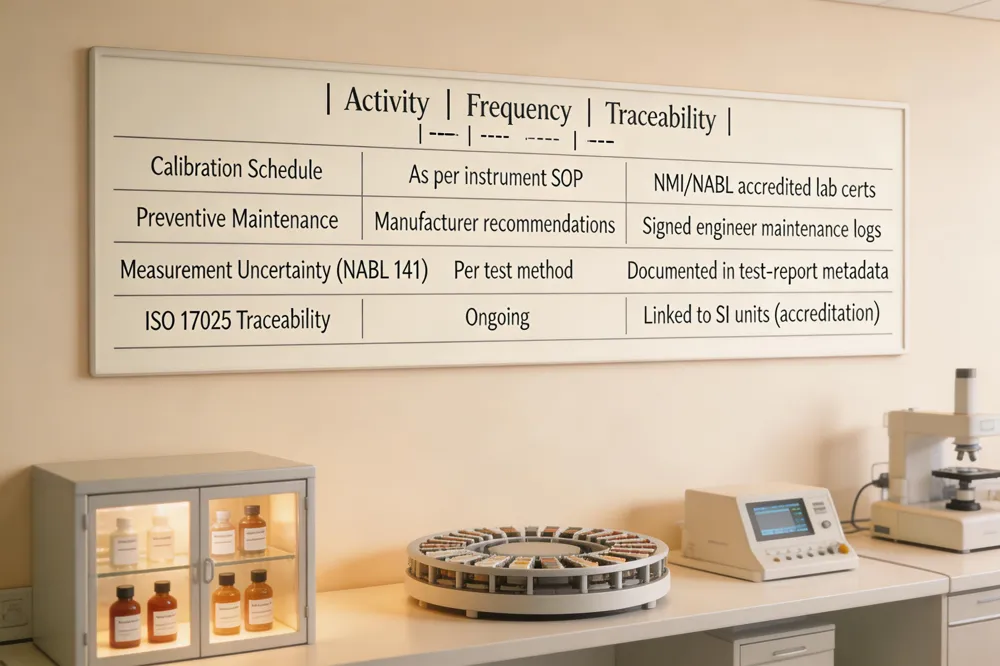
A robust equipment‑calibration programme begins with a documented schedule that lists every instrument, its calibration frequency, and the responsible technician. Preventive‑maintenance logs must capture routine service, parts replacement, and any corrective action taken, and each entry should be signed off by a qualified engineer. All calibration certificates must be traceable to a National Metrology Institute (NMI) or an NABL‑accredited calibration laboratory, ensuring that the measurement chain links back to SI units. NABL 141 provides the specific methodology for estimating and expressing measurement uncertainty; laboratories should calculate uncertainty for each test method, record the contributing components (e.g., repeatability, calibration uncertainty, environmental factors), and include the result in the test‑report metadata. By meeting ISO 17025’s metrological‑traceability requirement, the lab demonstrates that every result is anchored to internationally recognised standards, thereby satisfying both technical and accreditation criteria for diagnostic services such as those offered by Agam Diagnostics.
5️⃣ Conduct Proficiency Testing, Internal Audits, and Management Review
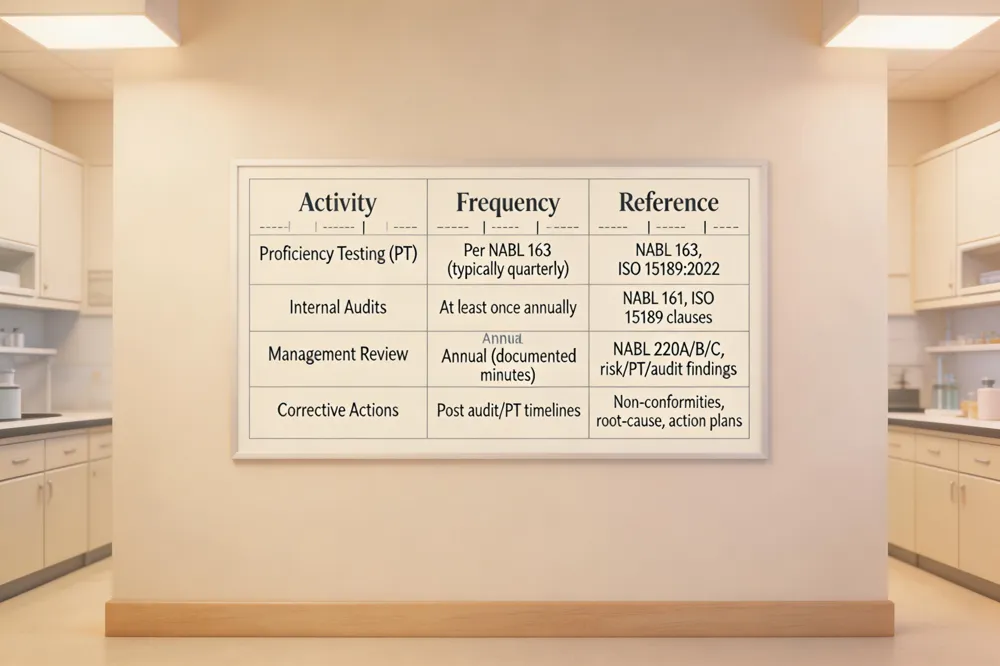
NABL mandates that every medical laboratory, including Agam Diagnostics, participates in proficiency testing (PT) as stipulated in NABL 163. Labs must enrol with NABL‑approved PT providers, submit results for each test discipline, analyse any out‑of‑specification findings and implement corrective actions before the next PT cycle. Continuous PT participation demonstrates analytical competence and satisfies the ISO 15189:2022 requirement for external quality assessment. For internal monitoring, NABL 161 provides the audit checklist used during the document‑review stage, while NABL 220A, NABL 220B and NABL 220C offer detailed checklists for ISO 15189, ISO IEC 17043 and ISO 17034 respectively. These checklists guide auditors through personnel competence, equipment calibration, SOP compliance, and record‑keeping. The laboratory must conduct at least one internal audit annually, document findings, and close non‑conformities within defined timelines. Finally, an annual management review meeting—recorded in formal minutes—must evaluate audit results, PT performance, customer feedback, and risk assessments, generating continuous‑improvement actions that are tracked and reviewed in subsequent cycles.
Putting It All Together for a Successful Accreditation Journey
Achieving NABL accreditation typically follows a six‑to‑eight‑month pathway: a rapid gap‑analysis, closure of identified deficiencies, preparation of a quality‑management manual and SOPs, submission of the NABL 155 application, internal audit, on‑site assessment, and final corrective‑action closure before the certificate is issued. Agam Diagnostics in Madurai exemplifies this route; its free home‑collection service and 24‑hour turnaround are built on the very SOPs and calibration records demanded by the checklist, demonstrating how operational efficiency and patient‑centric care can coexist with compliance. In the long run, accreditation brings international acceptance of test reports, eligibility for insurance and government contracts, and heightened patient trust overall.