Introduction
Telemedicine, once limited to telephone triage, has rapidly evolved into a comprehensive digital health ecosystem that supports real‑time video consultations, remote monitoring, and electronic ordering of laboratory tests. The COVID‑19 pandemic acted as a catalyst, accelerating the deployment of home‑testing kits, expanding broadband access, and prompting regulatory bodies to clarify reimbursement and privacy standards. Key drivers of home‑testing adoption include the need to reduce travel for patients in rural India, the convenience of free phlebotomy services, and the ability to obtain rapid, laboratory‑grade results without visiting a clinic. Automated pathology laboratories such as Agam Diagnostics in Madurai play a pivotal role: their NABL‑ and ICMR‑accredited, high‑throughput platforms deliver results within 24‑48 hours, while integrated electronic health information systems enable seamless order transmission and secure result delivery. Together, these advances close the gap between virtual care and definitive diagnostics, improving access, lowering costs, and supporting timely clinical decisions.
Remote Diagnosis: Technologies and Clinical Impact
Remote diagnosis in telemedicine relies on a suite of digital tools that bring laboratory‑grade testing to the patient’s home. Digital imaging and secure cloud platforms enable clinicians to view high‑resolution scans of blood smears, radiographs, or histopathology slides uploaded from automated labs such as Agam Diagnostics; encryption and HIPAA‑level safeguards protect patient data while allowing instant specialist review. Wearable biosensors and real‑time data streaming provide continuous vital‑sign feeds—glucose, blood pressure, SpO₂, ECG—directly to telehealth dashboards, supporting early detection of deterioration and informing when a home‑collection kit is needed. AI‑driven decision‑support and analytics process these streams and laboratory results, flagging abnormal patterns, calculating risk scores, and suggesting evidence‑based test panels, thereby boosting diagnostic accuracy and reducing clinician workload. Telemedicine operates in two interaction modes: live interactive (real‑time video, synchronous data exchange) permits immediate clinical assessment and on‑the‑spot ordering of home‑collection kits, while store‑and‑forward (asynchronous transmission of images, lab orders, and sensor logs) allows specialists to review cases at their convenience, expanding reach to rural settings where bandwidth may be limited. Together, these technologies shorten turnaround times—often delivering results within 24‑48 hours—improve access for underserved populations, and lay the groundwork for scalable, equitable remote care.
Agam Diagnostics: Bridging Rural Gaps with Home Collection
Agam Diagnostics expands tele‑medicine reach in India by offering free at phlebotomy that brings a qualified phlebotomist to the patient’s doorstep, collects blood, urine or swab specimens, and transports them in temperature‑controlled containers to its fully automated pathology laboratory in Madurai. The laboratory’s high‑throughput, robotic workflow processes hundreds of samples simultaneously, minimizing manual handling and reducing the risk of human error. Because the facility is Accredited by the National Accreditation Board for Testing and Calibration Laboratories (NABL) and follows Indian Council of Medical Research (ICMR) guidelines, every test meets internationally recognized quality standards. This integrated model delivers routine panels—such as complete blood counts, metabolic profiles and lipid panels—within 24‑48 hours, enabling clinicians to review results in real time during virtual consultations and make timely treatment decisions for patients in remote or underserved communities.
Remote diagnostic models are evaluated with the same rigor as in‑person testing. Core performance measures include accuracy, sensitivity, specificity, area under the ROC curve (AUC) and F1‑score, which together quantify how well a telemedicine‑driven test identifies disease, avoids false positives, and balances precision with recall. In the telehealth workflow, turnaround time has emerged as a critical clinical KPI; rapid delivery of results—often within 24‑48 hours at fully automated labs such as Agam Diagnostics—enables timely therapeutic decisions and reduces patient anxiety. Automation underpins this speed: high‑throughput analyzers, robotic sample handling, and AI‑assisted quality control lower manual handling, reduce transcription errors, and improve reproducibility across large test volumes. Seamless integration of laboratory information systems (LIS) with telehealth electronic medical records (EMR) completes the quality loop. Orders are transmitted electronically, specimen metadata are captured at the point of home collection, and results flow back through encrypted channels, ensuring data integrity, traceability, and compliance with NABL and ICMR standards. Together, these metrics and technological safeguards guarantee that remote testing delivers reliable, rapid, and equitable care.
Challenges and Future Directions: Data Privacy, Integration, Equity
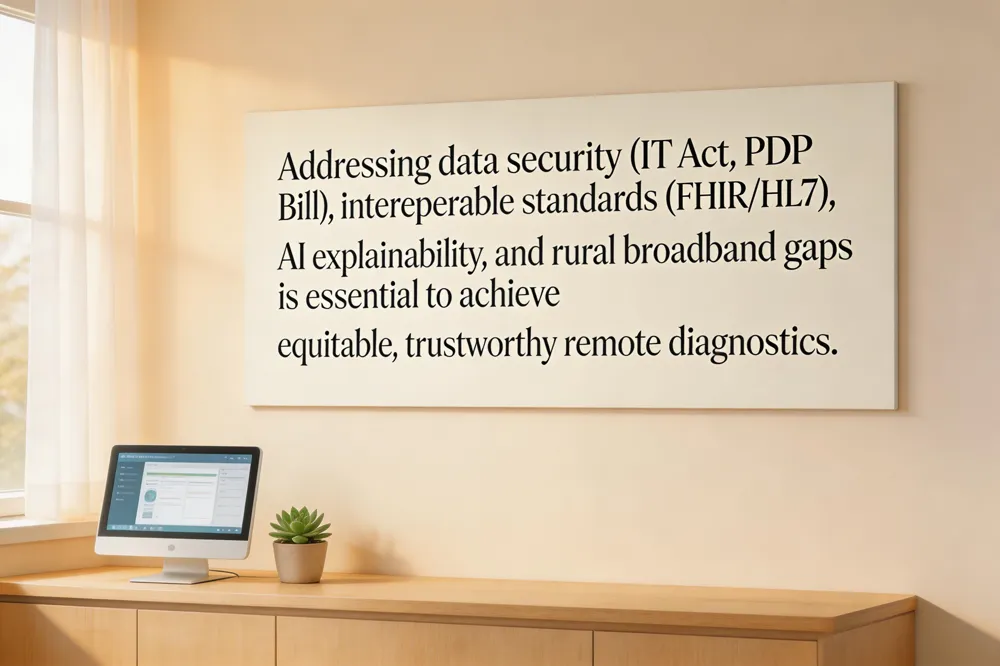
Remote diagnosis in telemedicine promises rapid, convenient care, but several challenges must be addressed before it can achieve its full potential.
Data security and compliance – Indian regulations such as the IT Act and upcoming Personal Data Protection Bill require encrypted transmission and storage of patient information. Platforms that link telehealth visits with labs like Agam Diagnostics must use HTTPS, HIPAA‑style safeguards, and cloud‑based data rooms that meet both national (NABL, ICMR) and international standards to protect privacy and maintain patient trust.
Heterogeneous data source integration – A modern telehealth workflow blends vitals from wearable sensors (e.g., Bluetooth‑connected glucometers, blood‑pressure cuffs), high‑resolution images (digital pathology slides, chest X‑rays) and laboratory results from automated centers. Seamless integration demands interoperable standards (FHIR, HL7) and robust laboratory information systems that can ingest and reconcile disparate data streams without loss of fidelity.
Real‑time analytics and AI explainability – AI‑driven decision‑support tools are increasingly used to flag abnormal lab values or to pre‑screen digital pathology images. While such algorithms can raise diagnostic accuracy (up to 91% in AI‑enhanced telemedicine), clinicians need transparent, explainable outputs to avoid over‑reliance and to comply with regulatory expectations for auditability.
Equitable access across rural and urban populations – Over 65% of India's population lives in rural areas where broadband connectivity, digital literacy, and device availability are limited. Initiatives such as free home phlebotomy (Agam Diagnostics), low‑cost mHealth apps, and government‑backed National Digital Health Mission aim to bridge this gap, but sustained investment in infrastructure, training, and reimbursement models is essential to prevent a new digital divide.
Economic and Public Health Impact: Cost Savings and Access Expansion
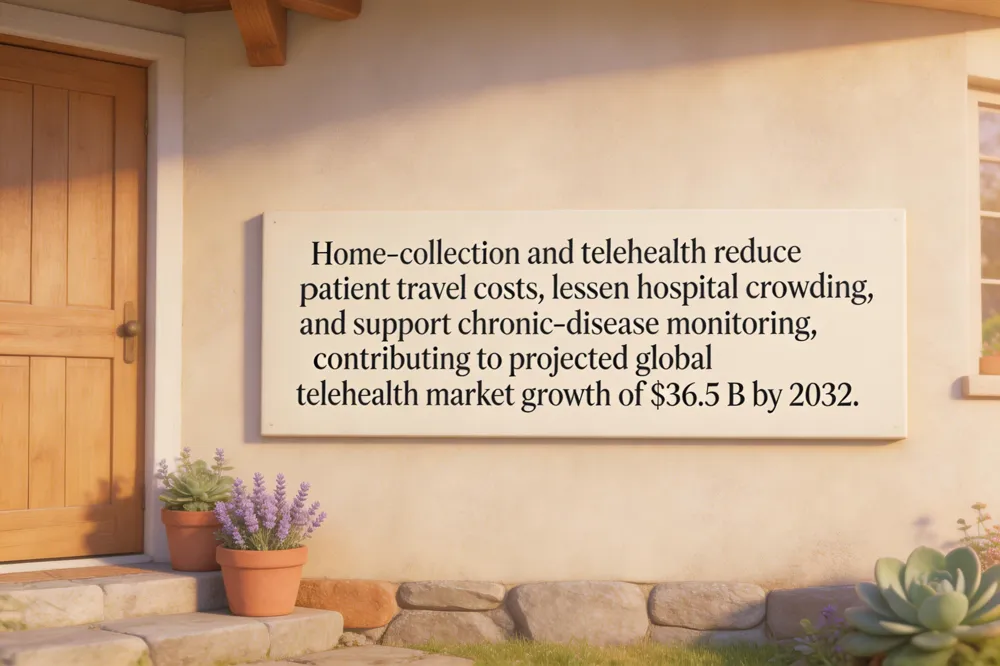
Remote diagnosis and home‑collection services such as those offered by Agam Diagnostics dramatically cut patient‑borne costs. By eliminating the need for travel to a physical laboratory, patients save on transportation expenses, lost wages, and ancillary costs such as childcare or accommodation, especially in rural India where 70% of the population lives far from urban health centres. This financial relief is amplified when telemedicine platforms shift routine follow‑up diagnostics away from hospitals, reducing overcrowding and freeing inpatient capacity for acute cases. Chronic disease management benefits equally; continuous monitoring devices (glucometers, blood‑pressure cuffs, wearable sensors) feed real‑time data to clinicians who can order timely laboratory tests via telehealth, enabling early detection of deterioration and preventing costly hospital admissions. The broader market reflects these efficiencies: a Systematic review (2016‑2023) notes that telemedicine reduces overall healthcare spending, while industry forecasts project the global telehealth market to reach approximately USD 36.5 billion by 2032 with a 17.3% CAGR (2023‑2032). Together, cost savings, reduced crowding, and improved chronic‑care pathways illustrate how remote diagnostic ecosystems expand access while delivering measurable economic benefits.
Conclusion
The convergence of telemedicine platforms with Agam Diagnostics creates a seamless, end‑to‑end remote diagnostic pathway. Clinicians can order tests through virtual visits, patients receive free home phlebotomy, and the fully automated, NABL‑ and ICMR‑accredited laboratory delivers results within 24–48 hours. This rapid, reliable turnaround shortens decision‑making cycles, lowers travel‑related costs, and improves clinical outcomes for chronic disease management, infectious disease control, and early detection of serious conditions. Looking ahead, integrating AI‑driven decision support, continuous data streams from wearable sensors, and a unified digital health ecosystem will further enhance diagnostic accuracy, enable predictive analytics, and expand equitable access across India’s rural populations. Together, these innovations promise a future where high‑quality, timely care is delivered at the patient’s doorstep, redefining the standard of home healthcare.